How to design a room with sloping ceilings – practical tips from a residential architect

1. Make the most of light and space
Rooms with sloping ceilings tend to feel smaller, so it is important to make the most of natural light. As a residential architect, I can recommend placing windows or skylights strategically so the space is as bright as possible. Light not only visually enlarges the space but also makes it airier.
Apartment or house design for you
2. Choice of colours
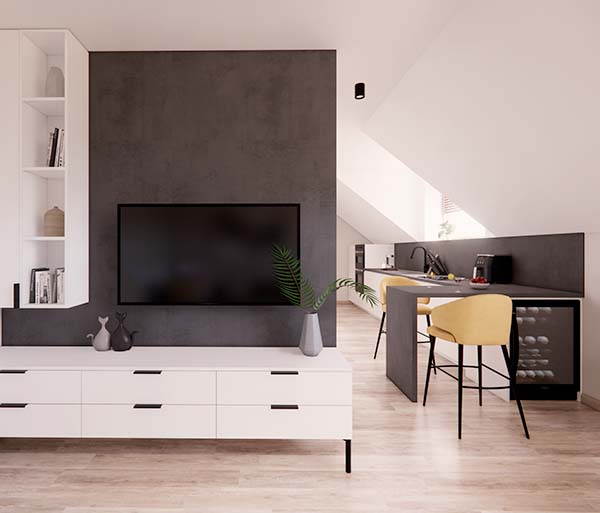
In smaller and sloping spaces, colours play an important role. Light shades on the walls and ceilings help visually expand the room. Light pastel or neutral colours can open up the space and make it more pleasant. Dark colours can be used for accent walls to add depth, but always sparingly.
3. Optimising storage
The space under sloping ceilings is ideal for custom storage systems. Built-in wardrobes, low shelves or made-to-measure storage boxes let you use every centimetre of the room efficiently. An interior design with these solutions helps keep the space tidy and organised without taking up too much room.
4. Focus on function and ergonomics
When designing an interior with sloping ceilings, it is important to pay attention to ergonomics. Furniture placement should be well thought out – for example, the bed should go where the ceiling is lower, because you don’t need as much height to lie down. On the other hand, work or dining zones should be in the part with the higher ceiling, so there is enough room to move freely.
5. Made-to-measure furniture
Made-to-measure furniture is often unavoidable in rooms with sloping ceilings. A home designer can help you design pieces that fit exactly into awkward angles and corners. Low chests of drawers, built-in benches or custom shelving systems, for example, are ideal for making the most of the space.
6. Visual tricks to make the space look bigger
Vertical lines, such as long floor-to-ceiling curtains, can help elongate the space. Mirrors are another great way to make a room look bigger. Large mirrors reflect light and create the illusion of a larger space.
7. Textiles and decorations
When decorating a room with sloping ceilings, the key is to keep it simple. Too many decorations can overwhelm the space. Light textiles such as sheer curtains or light rugs add cosiness without feeling heavy. Instead of lots of small decorations, choose a few more striking ones that unify the space and give it its own character.
8. The right lighting
Because of the irregular shape of the room, it is important to choose the right lighting. Wall lamps, spotlights or lamps with an adjustable angle can help light darker corners. The interior design of a room with sloping ceilings should include several light sources so the room is well lit from all angles.
9. Using ceiling beams
If the room has visible ceiling beams, they can become a striking design element. They can be painted to match the overall style of the room or left raw to add character. It is important, however, that they don’t look too massive.
10. Room height
Since sloping ceilings can reduce the perceived height of a room, it is worth choosing furniture and accessories carefully. Tall and bulky pieces can look too dominant. Lighter, lower furniture helps keep the space feeling open.
11. Safety – prevent accidents
In rooms with sloping ceilings there is a risk of hitting your head, especially where the ceiling is very low. To prevent this, it is a good idea to mark these places, for example with colour transitions or visible decorations that draw attention to the lower ceiling. Another option is to place furniture or house plants so that they prevent free movement in these risky zones and stop people from accidentally walking into them. This approach not only increases safety but also helps arrange the room so it is functional and clear. Safety is an important aspect of every interior design, whether it is a bedroom, a living space or a children’s room.
Rooms with sloping ceilings can be a creative challenge, but with a well-thought-out interior design and well-chosen elements they can become cosy and stylish spaces. A residential architect or home designer can help you make full use of the potential of these spaces and create a unique environment that is not only attractive but also functional.