Postforming or compact? Which worktop to choose for your new kitchen
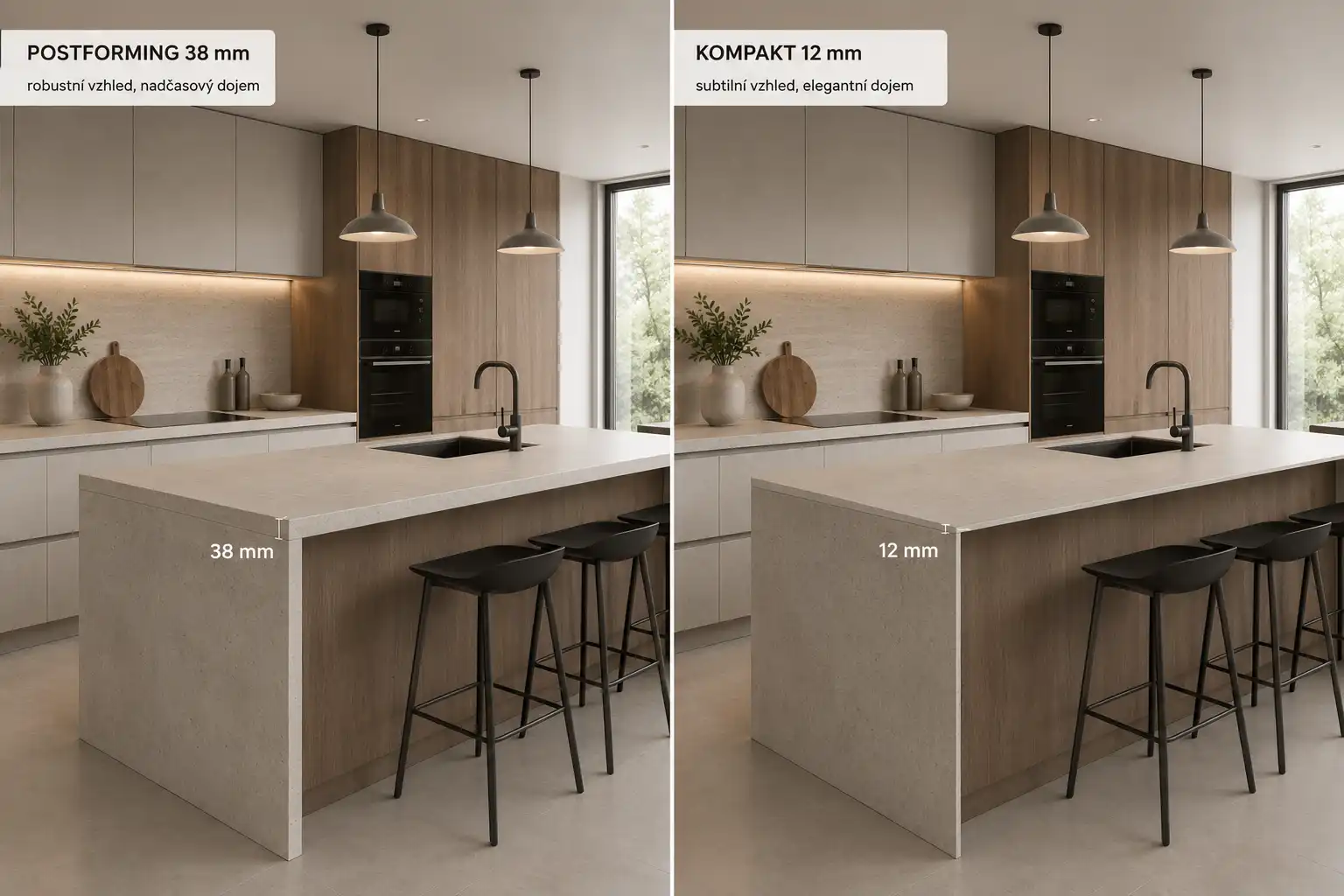
When designing a new kitchen, most clients consider not only the look of the fronts or the appliances but also the worktop. It is one of the most heavily used parts of the kitchen – every day it comes into contact with water, hot pans and ordinary kitchen dirt.
Most often the choice is between two options – a 38 mm postformed laminate worktop and a 12 mm compact worktop.
Which is better? There is no simple answer. It depends mainly on the budget, the desired look and the design details of the kitchen.
Quick comparison
| Feature | Postforming 38 mm | Compact 12 mm |
|---|---|---|
| Price | Reference price | Approximately 1.5–2× higher |
| Look | More robust, timeless | Thin, minimalist |
| Worktop thickness | 38 mm | 12 mm |
| Undermount sink | ✕ | ✓ |
| Routed drainer grooves | ✕ | ✓ |
| Visible edges without edge banding | ✕ | ✓ |
| Water resistance | Requires good sealing of cut-outs | Water-resistant throughout |
| Durability in everyday use | ✓ | ✓ |
| Easy maintenance | ✓ | ✓ |
| Hygienic surface | ✓ Non-porous | ✓ Non-porous |
| Range of decors | Very wide | Narrower (especially wood decors) |
| Service life | Long with correct installation and use | Long with correct use |
| Best suited for | Best value for money | Minimalist kitchens and more demanding details |
Price
If budget is important to you, a postformed worktop is the better value. It offers a very good balance of price, durability and service life.
A compact worktop is usually around 50 to 100% more expensive. Not only the material itself costs more, but often also its processing and installation.
Look
The look is the most common reason why clients choose one option or the other.
A postformed worktop looks more robust and suits almost any kitchen style.
A compact worktop, only 12 mm thick, creates a lighter, minimalist impression. It is most often used in modern kitchens with clean lines.
It is not about which option is better. What matters is the overall style of the kitchen.
Processing options
Here the compact worktop has a clear advantage.
It allows, for example, an undermount sink, routed drainer grooves or visible edges without edge banding.
A postformed worktop, on the other hand, uses a classic top-mounted sink, and cut edges need edge banding.
Water resistance
A compact worktop is water-resistant throughout its thickness.
A postformed worktop has a chipboard core that is not designed for long-term exposure to water. But that doesn’t make it less suitable for a kitchen. With professional installation and proper sealing of all cut-outs and joints, it will easily last many years of everyday use.
Range of decors
The advantage of postformed worktops is a very wide range of decors – from wood and stone imitations to plain colours.
Compact worktops usually have a narrower choice. This applies especially to wood decors, which some manufacturers don’t offer at all or only in limited numbers.
Which worktop would I recommend?
When designing kitchens, I most often choose a quality postformed worktop. In most households it offers an excellent balance of price, durability and looks, and with proper processing it serves reliably for many years.
I recommend a compact worktop mainly when the goal is a minimalist look or when the client wants an undermount sink, routed drainer grooves or other design details that a classic laminate worktop does not allow.
In the end, it is not only the technical parameters that decide, but above all the overall concept of the kitchen, the budget and the expectations of the final solution.
Take a look at our kitchen designs