
How colours in a children’s room shape personality

Practical tips for designing a children's room according to the child's temperament
Green and blue: colours that support concentration
Cool shades, especially blue and green, are ideal for supporting concentration and calm. These colours are often used in zones for learning and homework. Blue has a calming effect, reduces stress and supports concentration, as confirmed by a study by Mehta and Zhu (2009) [1]. Green, symbolising nature and balance, is great for improving the ability to learn and remember new information, as shown by research by Oberfeld and Hecht (2008) [2].
A residential architect advises: parents of children who have trouble concentrating should consider including blue or green in the study corner or around the desk.
Beige, pink and grey: colours that support relaxation
For children who have trouble relaxing or get upset easily, soft pastel colours such as light pink, beige or light grey are suitable. These shades create a calm and pleasant atmosphere. Studies show that soft colours reduce stress levels and contribute to better sleep quality [3]. Parents should consider using these colours in zones for rest and sleep.
Green: a colour that supports self-confidence, curiosity and memory
Green is again recommended for stimulating memory and curiosity. According to research by Choi and Kim (2020), green has a positive effect on memory and learning, which can improve a child’s ability to succeed and thus support their self-confidence [5]. Children who have trouble learning can benefit from being surrounded by green tones in the space where they study.


Red: action, competitiveness and aggression
Red is a very strong colour that symbolises energy, passion and excitement. It is a colour that can strongly stimulate physical reactions – it speeds up the heart rate, raises adrenaline levels and activates the senses. In a children’s room, red can support activity and competitiveness, which is ideal for children who lack energy.
On the other hand, red can also be too intense, which can lead to restlessness or even aggression in children who are sensitive to stimuli. That is why it is recommended to use red in smaller amounts, for example as an accent in decorations, cushions or toys. In zones for rest or study, the use of red should be limited to avoid excessive stimulation (Küller & Mikellides, 1993) [6].
Grey: neutrality and balance
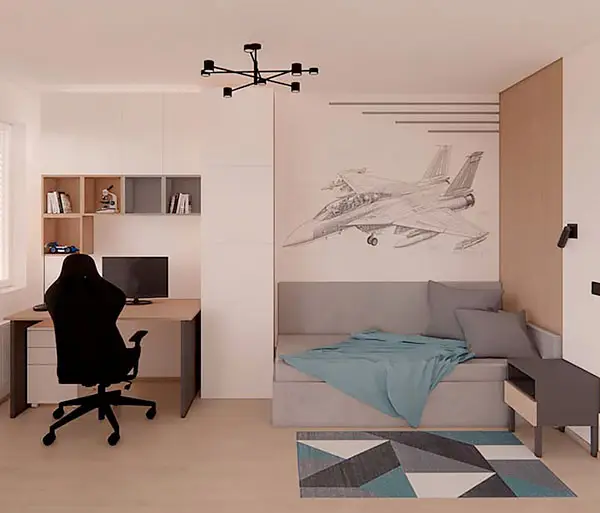
Grey is often considered neutral, meaning it doesn’t carry a strong emotional charge like red. In a children’s room, grey can be a great basic element that harmonises and balances colour accents, for example in combination with livelier colours such as yellow or orange. Grey brings a feeling of elegance and balance to the space, which is why it is often used in student rooms, where concentration and calm are important.
However, if there is too much grey in the interior, the space can feel cold and dull, which can lead to a loss of motivation and joy.
An interior designer advises: grey is best combined with warmer shades or natural materials that give the room a more pleasant, warmer atmosphere (Oberfeld & Hecht, 2008) [7].
Orange and yellow: colours that stimulate social interaction, creativity and playfulness
Children who need support for their creativity and playfulness can benefit from vivid colours such as yellow and orange. Yellow is associated with optimism and creativity and has been shown to support creative thinking (Green & Kidd, 2015) [4]. Orange encourages the desire to act and supports social interaction. These colours are ideal for spaces for play and creative activities. Parents who want to support their children’s confidence when interacting with others can use orange as an accent colour in playrooms or shared spaces.


When designing a children’s room, it is important to consider the child’s overall needs and personality. A residential architect or home designer can help parents choose the right colours and materials to meet their child’s psychological needs and support their development. The psychology of interior – the science of how space affects human behaviour – can be a useful tool when deciding which type of environment suits a child best.
Text: Svetlana Golounina
YOU MIGHT ALSO BE INTERESTED IN:


References to scientific research:
- Colours and concentration: Mehta, R., & Zhu, R. J. (2009). Blue or Red? Exploring the Effect of Color on Cognitive Task Performances. Science, 323(5918), 1226-1229.
- Colours and memory: Oberfeld, D., & Hecht, H. (2008). The Role of Background Color in Free Recall. Memory & Cognition, 36(7), 1223-1229.
- Colours and relaxation: Küller, R., & Mikellides, B. (1993). Color and Affective Evaluations of Indoor Environments. Scandinavian Journal of Psychology, 34(1), 91-105.
- Colours and creativity: Green, A., & Kidd, C. (2015). Color Psychology in Early Childhood Development: The Role of Yellow in Creative Thinking. Developmental Science, 18(2), 249-255.
- Colours and memory: Choi, Y., & Kim, H. (2020). The Influence of Green Environments on Memory Retention. Cognitive Psychology Journal, 42(5), 512-520.
- Red and stimulation: Küller, R., & Mikellides, B. (1993). Color and Affective Evaluations of Indoor Environments. Scandinavian Journal of Psychology, 34(1), 91-105.
- Grey and its effect on emotions: Oberfeld, D., & Hecht, H. (2008). The Role of Background Color in Free Recall. Memory & Cognition, 36(7), 1223-1229.